Expat Finances in Northern Cyprus in 2026
When someone moves to Northern Cyprus, the first difficulties are usually not connected with property, residency, or adapting to a new country. The real problems start a little later — when it turns out that you have to live on the island within one financial system, while your money remains in a completely different one.
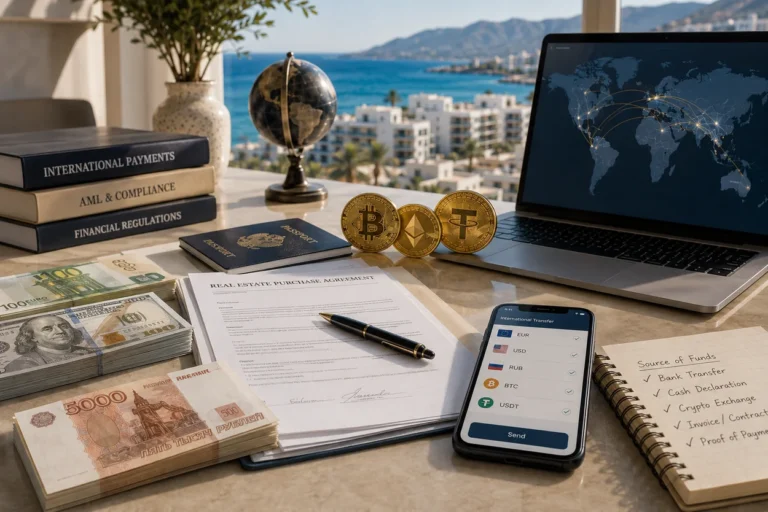
This is a very typical story for expats in the TRNC. Income may stay in Russia, Kazakhstan, Ukraine, or Europe, or it may come from international clients and businesses altogether. Some people receive money in cryptocurrency, others from renting out property, remote work, or foreign companies. But this money has to be spent here: paying rent, filling up the car, buying groceries, paying for a child’s school, or servicing an installment plan on a property.
And it is at exactly this moment that a person comes face to face with the reality of a cross-border life: they have the money, but actually using it conveniently is not always simple.
After 2022 this problem hit Russian citizens especially hard. Previously, many calmly topped up local accounts with transfers from Russian banks and gave no thought to financial infrastructure at all. Today international transfers work in a much more complicated way, some of the familiar banking tools have ceased to be available, and financial logistics itself has become a separate task that has to be solved constantly.
At the same time, Northern Cyprus is neither Europe nor Dubai. It has its own banking system, its own logic of international settlements, and its own everyday peculiarities. And the longer a person lives on the island, the faster they realize: for a normal life here you almost always need a combination of several financial instruments at once.
Which Currencies Northern Cyprus Lives In
One of the first things an expat has to get used to is that Northern Cyprus effectively lives in several currencies at once.
The Turkish lira is used for everyday expenses. In it you will buy groceries and pay for petrol, cafes, taxis, and utilities. But at the same time, most people try not to keep large sums in lira. Inflation in Turkey remains high, so the lira is seen more as an operational currency for living than for savings.
Property, cars, and long-term rentals are most often tied to the British pound. That is exactly why many expats who buy an apartment on an installment plan or rent housing for a long term constantly run into the need to convert currencies.
Dollars and euros remain the currency of savings and international settlements. And at some point almost every expat gets the feeling that they are living inside three financial systems at once.
How Banks Work in Northern Cyprus
The banking system of the TRNC differs greatly from the one people are used to in Europe or the CIS countries.
Yes, it is quite feasible for a foreigner to open an account here. Usually this requires a passport, proof of address, a rental or property-purchase contract, and sometimes a residency permit or documents showing it has been applied for. But beyond that, nuances begin that many people turn out not to be ready for.
For example, the issuance of an ordinary personalized card can take several weeks. Many local cards do not work with Apple Pay and Google Pay. Some international transfers go through the Turkish banking system and may require additional checks. And the level of digitalization of banking services here is still noticeably lower than in Europe or the UAE.
At the same time, almost every expat still needs a local account. Without it, it is hard to fully integrate into local life: paying utilities, arranging residency, using certain services, or carrying out large deals.
Why Many People Start Using Cryptocurrency After Moving
A very interesting feature of Northern Cyprus is that cryptocurrency here long ago stopped being purely an investment instrument.
For a large number of expats it has become part of everyday financial life.
The reason is fairly simple. When a person lives between several countries, receives international income, or works with foreign clients, the classic banking infrastructure starts to work slowly, expensively, and not always reliably. Especially when it comes to cross-border transfers.
Against this backdrop, USDT and other stablecoins have become, for many, an ordinary instrument of financial logistics. Through cryptocurrency people:
- receive payment;
- transfer money between countries;
- service installment plans;
- pay for large purchases;
- build liquidity for living on the island.
But here it is important to understand one thing: cryptocurrency itself does not solve the problem completely. The money still has to be used somehow in everyday life. It needs to be spent in shops, used to pay for subscriptions, to buy plane tickets, to settle rent, or simply to have access to everyday expenses.
This is exactly why a whole additional infrastructure of services is gradually forming around cryptocurrency.
How Expats Actually Use Money on the Island
In practice, the financial life of most expats in Northern Cyprus looks far more complicated than it seems from the outside.
A person may have:
- income in one country;
- a bank account in another;
- cryptocurrency as the main way of moving capital;
- cash for local expenses;
- a local account for life inside the TRNC.
And all of this constantly has to be tied together.
That is exactly why many, over time, start using not a single banking product but several instruments at once.
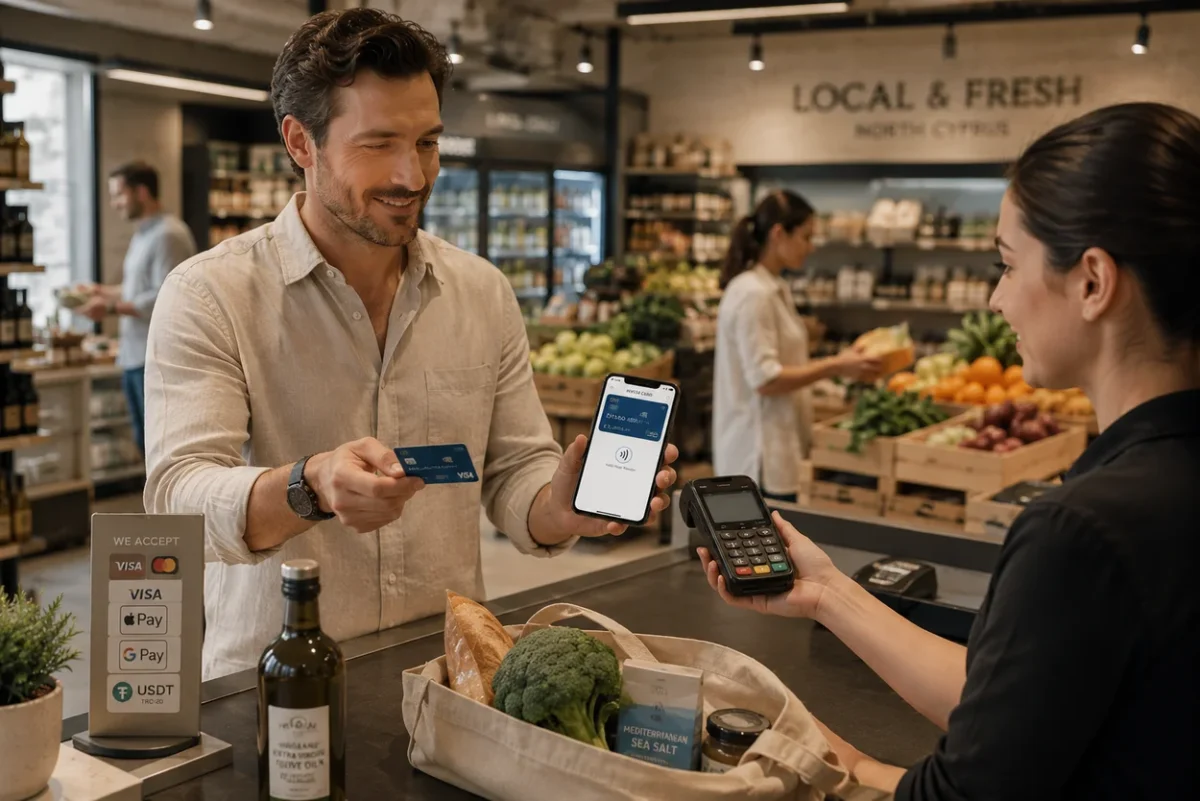
For example, for everyday expenses many people use crypto cards. At Invista this is a separate service that makes it possible to issue virtual cards and connect them to Apple Pay and Google Pay. Such cards are convenient to use for ordinary life: paying in shops, for subscriptions, plane tickets, Booking, and online services. The balance can be topped up in various ways, including with cryptocurrency, and the conversion happens at the rate of the payment system and the card issuer.
For some expats this becomes the most convenient bridge between international income, cryptocurrency, and ordinary life on the island.
Why the Question of Transfers Never Goes Away
Even if a person has already been living in Northern Cyprus for several years, the problem of international transfers does not disappear anywhere.
Money may remain:
- in Russian accounts;
- in foreign banks;
- in cryptocurrency;
- in a business;
- in property or other assets.
But to live on the island it regularly has to be turned:
- into lira for everyday expenses;
- into pounds for rent or property;
- into dollars and euros for storage and international payments.
And here almost every expat, sooner or later, starts looking not simply for a “money changer” but for a stable system of financial logistics that will let them use their money calmly in a new country.
At Invista we help build exactly this kind of infrastructure. For some it is international transfers, for others working with cryptocurrency, for others conversion, topping up cards, or getting cash on the island. But the essence of the task is almost always the same: to make sure a person can comfortably use their own money regardless of which country it was earned in.
Why Cash in Northern Cyprus Still Matters
Another feature of the TRNC that all expats quickly get used to is that the island still remains a fairly “cash” economy.
Even if you have cards, bank accounts, and cryptocurrency services, it is hard to move away from cash completely here. Small cafes, everyday services, some local payments, and many everyday situations are still more convenient to handle precisely with cash.
That is why an expat’s financial life in Northern Cyprus is almost always built as a combination of different instruments. And the better a person builds this system to suit themselves, the calmer and simpler their life on the island becomes.